

Dark night of the marketing soul
(are marketers beyond salvation?)

Last year I reached stage 4 in the ‘leaving corporate’ de-conditioning process: do I even want to do [X thing] that I’ve been engaging in and getting paid to do for [X] number of years? Do I even want this ‘career’? Do I want a career at all?
(…the answer to all of which is of course James Baldwin’s quote, ‘I have no dream job. I do not dream of labour.’)

This was partly inevitable; a function of enough time having elapsed and space having been found to truly peel back the layers on this new modus operandi and its possibilities. But another larger part, that had been festering for far longer, was a growing cynicism with the profession I’ve worked in for the last dozen years.
Marketing was giving me the ick.
It was a feeling I simply had to put up with and ignore best I could whilst shackled to my monthly salary. Too numb and too trapped to dig too deeply into the unease that had crept in and taken up permanent residence in my mind. Unease that was twofold:
One, my complicity in actively benefiting from a company at the heart of a system that is so evidently not in service of the greater or greatest good, no matter what our purpose statement said (I worked in financial services).
And two, the nature I of my role in said system: marketer. Communicator. Brand manager. Meaning maker. Messenger.
marketing | ˈmɑːkɪtɪŋ | noun
the activity or business of promoting and selling products or services, including market research and advertising
propaganda | ˌprɒpəˈɡandə | noun
information, especially of a biased or misleading nature, used to promote a particular cause, doctrine, or point of view
rhetoric | ˈrɛtərɪk | noun
the art of effective or persuasive speaking or writing…language designed to have a persuasive or impressive effect, but which is often regarded as lacking in sincerity or meaningful content
manipulate | məˈnɪpjʊleɪt | verb
control or influence (a person or situation) cleverly or unscrupulously
The dictionary tells us these are different words, but in reality the distinction is hardly finite. Marketers are manipulators. Or at least ‘attempted manipulators’. Which is akin to ‘attempted murderers’ in that we may not always succeed, but that doesn’t mean we should be let off the hook.
It is no coincidence that so many marketers have a background in psychology or more than a passing interest in it. Or what about our burgeoning obsession with behavioural economics and anthropology? No humanist subject or study is safe from being extrapolated into a form of strategic marketing insight, co-opted into the mighty science of persuading people to buy more, use more, and at the very least, pay more attention.
We convince ourselves that we manipulate with good intentions, in a way that seems perfectly harmless, by offering a ‘solution to a problem’ or ‘meeting a need’, or perhaps we are only ‘informing and educating’ our target audience rather than selling to—but we manipulate all the same.
We chase targets. We track KPIs. We measure the success of our manipulations in a huge array of metrics. We reduce individual human beings to faceless ‘audiences’, ‘customers’, ‘markets’—or, tying for equal worst place in the lexicon, ‘users’ and ‘consumers’.
So if they’re consumers and users what does that make us? Feeders and pushers? Shoving advertising down their throats and injecting it into their veins at every opportunity?
It was easier to distance myself from the reality of my clever manipulations in a B2B environment. The consequences were so far downstream and I was such a small cog in such a large machine that was mostly indifferent to my efforts anyway. After all, we weren’t selling people crap that they don’t need: we were selling the infrastructure that moves the capital that fuels the businesses that produce the crap that people don’t need.
See? Far more degrees of separation. Each degree a little extra padding between my culpability and the late stage capitalist nightmare I was enabling, a cushion to help me sleep soundly at night.

I recently had an interaction on LinkedIn that captured this tension between the role of marketing in an organisation and the role of marketing in society at large.
The original post was about an MI6 recruitment drive aimed at working mothers, asserting that it was reinforcing cultural stereotypes (“polishing the glass ceiling”) by not speaking to working parents in general and not having a dad-focused counterpart. Bethany Joy, a brand voice strategist I’m connected with, commented that the actual problem was “expecting marketing to be a force for social change”.
And it wasn’t so much the reasoning behind Bethany’s comment, or the logic of her argument, so much as that exact sentence which triggered this rant from me…that and the assertion that: “as humans, we want to challenge stereotypes. As marketers, we rely on them.”.
She’s not wrong there, but the truth doesn’t lessen the sting of culpability. Or frustration.
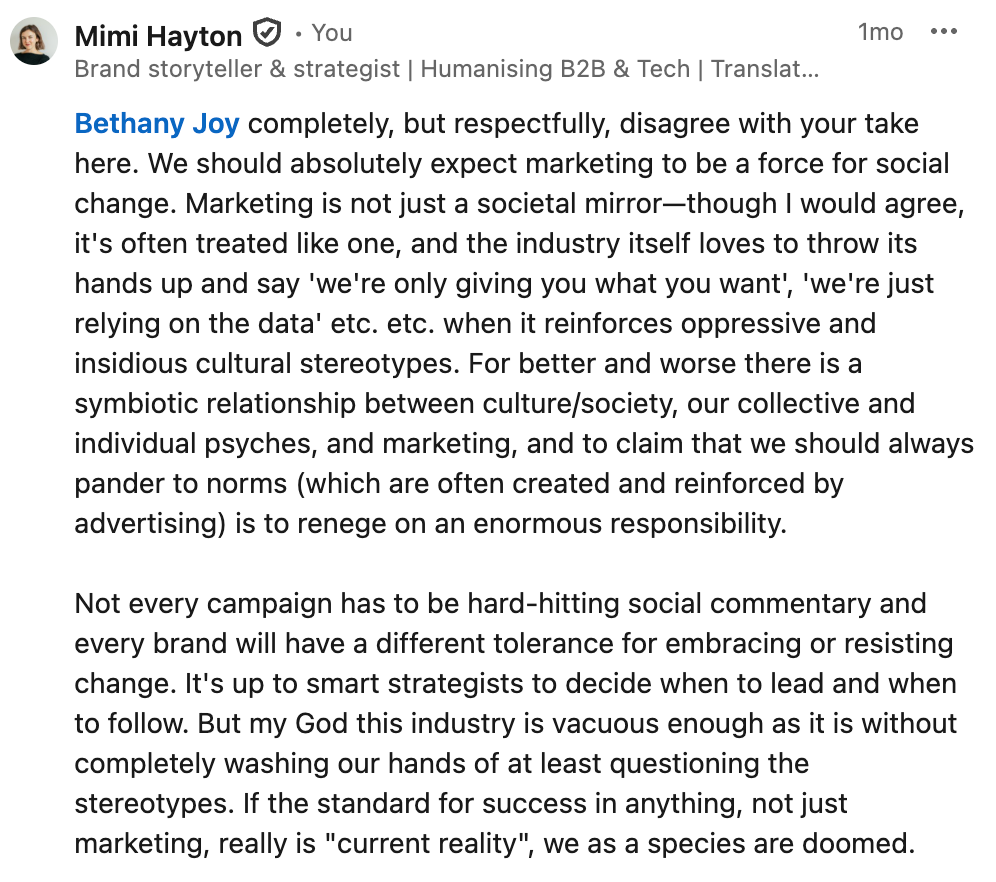
Clearly, I came in more than a little gung-ho (LinkedIn does that to me). I was feeling riled up about about the state of the world and I projected my feelings about our profession at large onto a discussion that deserved more nuance. In fact, once I calmed down and read things with a clear head, I agreed with Bethany’s follow up comments.
…but my despair remains.
As marketers we are tasked with a job. Bethany put it well: “The point of marketing is to elicit a response. You need to resonate with people to move them to act.”
Sometimes we are moving them to act in ways that could be culturally transformative if achieved at scale. And sometimes we are moving them to act in ways that, beneath our alluringly constructed surface, are very much against their own interests.
We are middle (wo)men caught between commercial imperative and social reality. And we are all too comfortable in this ‘middle’ role. It absolves us of any responsibility for the outcomes that we facilitate. For the messages that we deliver with a smile, whether we believe them or not, and the harm that they may be causing, whether or not the symptoms are immediately apparent.
For the cultural poison that we sweeten and deliver in pretty boxes wrapped up with ribbon so that this quarter’s targets are met.